
There’s a conversation that happens on rigs more than it should.
Someone asks which tong to use. The answer comes back “whatever’s on the rack.” Job gets done. Connections get made. Operation moves forward. Then something fails downhole three weeks later, and the root cause traces back to a makeup that was close enough but not right — wrong torque range, wrong jaw configuration, wrong tool for that specific tubular.
That sequence is expensive every single time. And avoidable every single time, too.
Why Hydraulic Power Tongs Changed Well Service Operations
Before hydraulic tongs became standard, pipe makeup relied on manual effort and operator feel to hit torque specifications. That creates inconsistency — the first connection of the day might be fine, the fifteenth might be undertorqued because someone’s tired, the fortieth overtorqued because something got rushed.
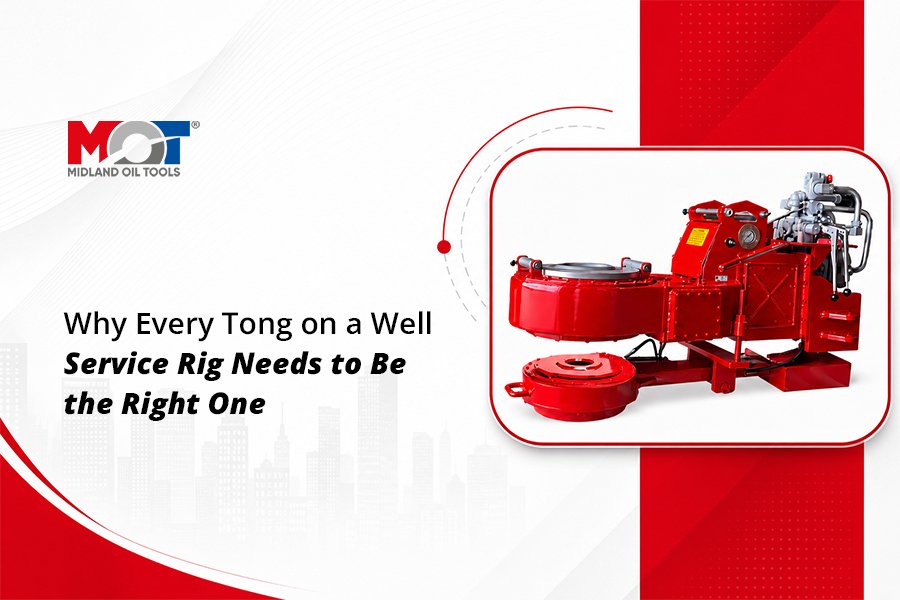
Hydraulic power tongs removed that variability. Used for running or pulling tubular strings during well repair, workover, snubbing, drilling, and casing operations, they apply consistent measurable torque across every connection regardless of where in the shift that connection happens. That repeatability across hundreds of connections is what prevents the cumulative makeup problems that show up as integrity failures later.
Sucker Rod Power Tongs — Where Uniformity Matters Most
Rod work has a specific failure mode, which general tubing tongs don’t address properly.
An undertorqued rod connection doesn’t fail at the surface where someone can see it. It fails downhole, at load, after the well’s been back in production for a while. By the time that failure shows up, it’s already caused damage costing multiples of what the correct makeup would have originally.
Sucker rod power tongs apply correct, uniform torque specifically calibrated for rod connections, handling rod sizes from 5/8-inch upward. That uniformity across every single connection — not most, every — is what separates a proper rod tong from a general-purpose tool that technically fits but doesn’t apply torque correctly for rod work.
Tubing Power Tongs — Precision Over Speed
Tubing connections sit in a precise torque window that’s narrower than most people outside tubular engineering fully appreciate.
Tubing power tongs make up and break out production tubing efficiently, but overtorque here is as damaging as undertorque. Overtorqued tubing connections damage the thread form in ways that create underground leak paths — not immediately visible, but guaranteed to cause problems eventually.
Casing Power Tongs — High Torque, No Shortcuts
Casing power tongs operate at the opposite end of the torque spectrum, reaching up to 21,000 ft-lbs depending on casing size and connection type. An undertorqued casing connection doesn’t just leak — it can compromise well integrity entirely, requiring remedial work far more expensive than the original casing job. High-torque output needs consistency across every connection, not just under ideal conditions.
Drill Pipe Power Tongs and Sustained Operational Demands
Drill pipe power tongs face a different environment than workover equipment. Drilling operations cycle connections repeatedly across variable pipe grades at a pace that exposes build quality weaknesses fast.
A tong that performs adequately during commissioning but develops inconsistency under sustained drilling pace creates connection quality problems before anything visible flags it. Build quality and hydraulic system reliability matter more here than on intermittent well service work.
What API Standards Actually Mean in Practice
All five tong types need to meet API 7K and 8A standards — not as a paperwork exercise, but because equipment that doesn’t meet them fails in ways that create real safety consequences rather than just operational inconveniences.
Midland Oil Tools manufactures across all these tong categories under ISO-9001 quality procedures with verified API compliance, meaning standards apply to the actual manufacturing process rather than just appearing on a spec sheet at the point of sale.
Right tong, right tubular, right standard. That combination is what keeps connections holding and operations moving forward without expensive surprises downhole.